
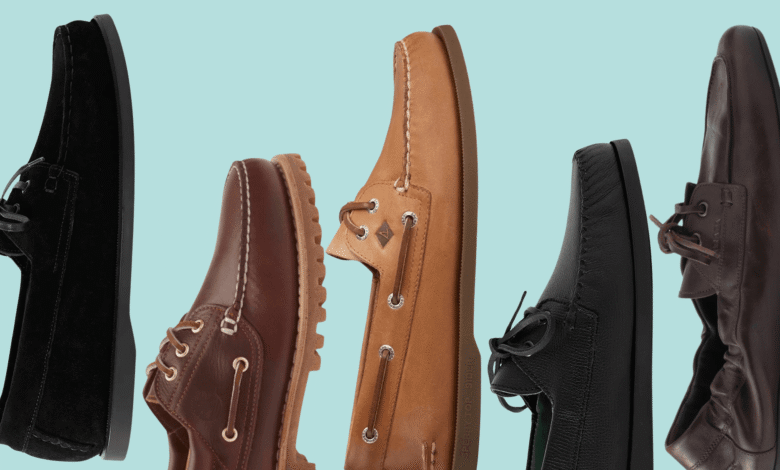
Style is a wave, and the best boat shoes for men are cresting right about…now. The boat shoe has already lived a few lives in the zeitgeist, from niche marine footwear to preppy staple, dad classic, and frat bro basic. But the tides have once again turned in its favor, and for the last few years it’s been back, and better than ever.
This year the boat shoe finds itself with more street cred than decades past, as cooler labels—Saman Amel, Auralee—continue to experiment with the easy-breezy footwear, and old hands — like Sebago and boat-shoe inventor Sperry—riff on their bread-and-butter style.
This means you’ve got a marina’s worth of options to choose from before you set sail on the Good Ship Boat Shoe. There’s no shortage of classics that will channel the Kennedy aesthetic, but you’ll also find upper-deck alternatives galore, like suede takes for a swank beachside wedding, chunky-soled BBQ stompers, and dainty Japanese city-strollers. The 15 below are, truly, ready for you to board.
Any list of the best boat shoes has to start with Sperry—as in, Paul F. Sperry, who invented the boat shoe in 1935 after realizing that his dog’s grooved paws could grip a ship’s wet deck better than his own kicks. So he made some rippling slices (“sipes”, technically) in the soles of his mocs, and created a whole damn shoe. Today’s Sperry Authentic Original, as the name suggests, shares a lot with the O.G.: a handstitched toe, leather uppers, and of course, that tried-and-true siped sole.
Best Upgrade Boat Shoes: Sebago Portland Leather Boat Shoes
There’s a reason that it’s Sebago, not Sperry boat shoes you see being worn by the stylish grandfathers strolling the Upper East Side. Like the latter, Sebago has been making boat shoes for longer than you’ve been alive, and the brand’s Portland model (as in Maine, where Sebago’s based), hits all the marks: unlined for comfort, full-grain leather that can handle some salt spray, with hand-stitched uppers for durability. And it’s exactly that hand-stitching and premium leather that gives Sebago the slight edge over its louder competitor.
If the O.G. boat shoe’s slim, non-slip sole veers a little too prep for you, Timberland’s version puts some meat on its bones with a hefty lugged sole reminiscent of the New York brand’s famous boots. Thick Horween leather (a.k.a., the good stuff) and rawhide lacing add to the ready-for-anything stance. Even if “anything,” in this case, means going back for seconds on ribs and slaw.
Yuketen is what you’d get if you mashed together L.L. Bean Americana with Louis Vuitton-level leatherwork. The brand’s known for finding artisans who can make beautiful, rugged pieces channeled through the heritage-obsessed vision of Japanese designer Yuki Matsuda. The Hex Eye Boat Shoe’s full-grain leather from Chicago’s famed Horween Leather tannery is cut, sewn, and assembled in the US using true moccasin construction on traditional moccasin lasts from the 1950s. That means the leather uppers wrap around the bottom of the foot, giving these boat shoes a soft, socklike feel. But to add a little Yuketen edge to the mix, the boat shoes are plopped onto a Cortina lugged sole which is developed in Italy and originally meant for scaling the Italian Alps. Damn.
We’d wager that the most successful new boat shoe in recent memory is Saman Amel’s City Moc, which is slated to be restocked for the fifth or sixth time due to excessively high demand. Stockholm atelier Saman Amel’s handmade-in-Italy moc has a tough, comfortable rubber sole, but on top of it sits a quiet silhouette—no contrast side lacing here. This means they can play with a suit as well as some denim, and it’s exactly that versatility that has had so many folks willing to fork out the admittedly eye-watering $670 for a pair. And note: If the suede isn’t for you, it also comes in brown and black pebble-grain leather, though those styles tend to sell out a little faster.
Boat shoes are meant to be as easygoing as a Bud Light on a back deck, and they’ll work anytime you’re relaxing in the sun. More on this below, but you can wear them with shorts, chinos, trousers, jeans, and especially bathing suits.
Speaking of suits, that’s when things get a little more complicated. The boat shoe can absolutely anchor a two-piece, but that pairing depends heavily on the time of day and the dress code, explicit or implied. If you’re wearing a suit for your own sartorial satisfaction — say, to a friend’s birthday brunch, or just because — then a boat shoe should be fine. You’ll probably want a suit in cotton, linen, or something equally casual.
When it comes to weddings or the office, unless the invite says “seaside casual” or your boss regularly conducts meetings on his yacht, we’d probably skip all but the most sophisticated boat shoes and opt for a more elegant member of the loafer family. Between the Venetian loafer, the horsebit loafer, and other loafer styles, you’ve got no shortage of options.
Bottom line, the boat shoe is the sneaker of the seas; a casual, daytime-skewing piece of footwear best enjoyed without socks or Slack alerts. None of this is written in stone anywhere (that we know of), and you retain your legal right to freak anything, anytime. But if you’re in doubt about the boat shoe’s sea-worthiness at an establishment or event, we’d suggest going with something even slightly more formal to avoid any “uncle who only wears Hawaiian shirts” energy.
As per our previous section, you can pull off boat shoes with most of your closet. Shorts or a bathing suit are absolute no-brainers. (Nothing goes from beach to boardwalk like boat shoes.) As are jeans — maybe in white or off-white, because it’s summer, and why not — as well as trousers, linen pants, and every type of chino under the sun, wide-legged or straight, pleated or flat, beige or covered in small embroidered whales.
Up top, if you can wear it with jeans or chinos, it’ll go great with boat shoes. Tees, polos of all types, camp shirts, crewneck sweatshirts, button-front shirts (tucked or untucked; white, Oxford, or other)… all besties with boaters. A sport coat with jeans and some boat shoes for a chill brunch? Ahoy-hoy! We love it. You will, too.
If we had to make one of those warning signs near the lifeguard chair, the kind with all the DON’Ts written in red text, the list would be small: no black tie or business suits. Otherwise, go forth and live your best boater life.
If you’re wearing a boat shoe while sailing on an actual boat, you’ll want what originally made the shoe distinct: a siped rubber sole designed to grip a slippery wet deck.
But we’d wager that 99 percent of boat shoes wearers will never reef a mainsail, so you’re really looking for good construction and easy comfort.
Quality leather is a good place to start. Anything from Horween, the heritage leather tanner in Chicago, means your feet are in good hands. Thicker leather will take a bit to break in, and may chafe at first (shout out to Dr. Scholl’s moleskin, savior from achilles burn), but it’ll hold up well and eventually fit your feet like a glove. Waxed leather will shrug off most water short of you falling overboard. Suede, on the other hand, is suede: it’s not so hardy, but it’ll be soft on your dogs, and particularly supple from the box if you opt for a boat shoe without a lining.
Genuine moc(casin) stitching, like in the Yuketen pair above, means the upper’s leather folds under the footbed. You’ll feel the extra softness in every step. You’ll also pay a bit more, because genuine moccasin construction requires more leather and more work.
Finally, a note on fit: When you try on a pair, try them on the way you plan to wear them. If that’s without socks, do it without socks. Leather shoes will stretch a little bit, particularly as you wear them throughout a wet hot American summer.
Style is subjective, we know—that’s the fun of it. But we’re serious about helping GQ readers get dressed. Whether it’s the best white sneakers, the best affordable suits, or the need-to-know menswear drops of the week, GQ Recommends’ expertise is built on decades of combined men’s fashion knowledge, years of hands-on experience with these brands and products, and an insider awareness of what’s happening in menswear.
So while GQ writers and editors can’t try on every single piece of clothing that we write about, the pieces we endorse are backed by first-hand knowledge of a brand’s strengths, bolstered by a deep understanding of the hallmarks of quality clothing—from materials and sourcing to craftsmanship and sustainability.
GQ Recommends heavily emphasizes our own experience with all the brands we select, review, and endorse, while also taking into account how a brand’s clothes have been reviewed by customers. Bottom line: GQ wouldn’t tell you to wear it if we wouldn’t.
We make every effort to cast as wide of a net as possible, with an eye on identifying the best options across three key categories: quality, fit, and price.
To kick off the process, we enlist the GQ Recommends braintrust to vote on our contenders. Some of the folks involved have worked in retail, slinging clothes to the masses; others have toiled for small-batch menswear labels; all spend way too much time thinking about what hangs in their closets.
We lean on that collective experience to guide our search, culling a mix of household names, indie favorites, and the artisanal imprints on the bleeding-edge of the genre. Then we narrow down the assortment to the picks that scored the highest across quality, fit, and price.
Across the majority of our buying guides, our team boasts firsthand experience with the bulk of our selects, but a handful are totally new to us. So after several months of intense debate, we tally the votes, collate the anecdotal evidence, and emerge with a list of what we believe to be the absolute best of the category right now, from the tried-and-true stalwarts to the modern disruptors, the affordable beaters to the wildly expensive (but wildly worth-it) designer riffs.
Source: www.gq.com